Crime Show – Murder at the Oakhill Hotel
A historic hotel full of eccentric guests, family secrets, and… a murder that sets off a torrent of accusations. Will…

Step into the heart of a criminal intrigue and feel like the hero of a good crime novel. Here, you're not just watching from the sidelines – you and your team are leading the investigation!
Team-building event for companies from 10 to 500+ people
Free quote within 24 hours
Check out the TOP scenarios for investigative role-playing games

A historic hotel full of eccentric guests, family secrets, and… a murder that sets off a torrent of accusations. Will…

A serial killer is on the loose in the art world. Each crime becomes his next work, and you…

A saloon, a sheriff, cowboys, and the biggest race in the Wild West. When a fight occurs just before the start…

At this luxury hotel, nothing is as it seems. Each guest harbors a secret…

An election campaign, local political ties, a priest involved in politics, and embittered fans. The assassination attempt on the mayor reveals…

A Nordic tribe prepares for a great expedition to find a legendary treasure. The unexpected death of Jarl's successor turns…

A stereotypical Polish village: gossip, pierogi, moonshine, and… murder. Welcome to Stara Wieś, straight out of a TV series…

A unique investigative puzzle awaits you. In one room, at one table, with limited information…

Lapland is in turmoil: the elves are protesting, the reindeer are rebelling, Santa Claus is losing her patience, and to make matters worse…
Detective investigations in which participants become the heroes of a crime story.
Company integration
When you want more than simple integration.
Training with a trainer
Entertainment and development of soft skills.
Gala or corporate dinner
An attraction that is hard to stop talking about.
You enter the game world
You learn the plot, the rules and divide into investigative teams.
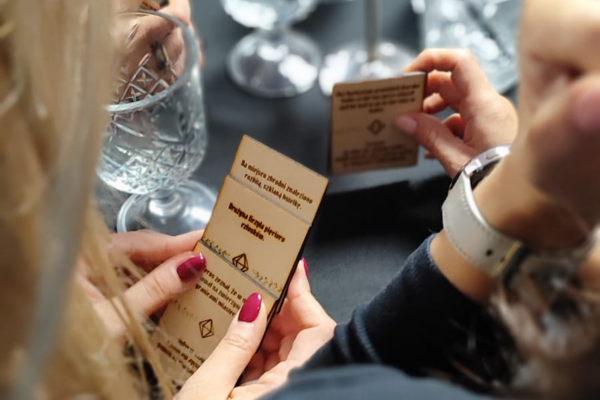
You are taking over the case files
You get the evidence, the first leads and you establish a plan of action.
You are interrogating suspects
You ask any questions, check alibis and spot contradictions
You connect the facts
You analyze the testimonies, evidence and build your own theory of events.
You give your verdict
Each team identifies the perpetrator and presents their version of the investigation.
You place your bet
Each participant votes individually, placing a bet according to their own convictions.
The truth comes out
You'll learn the solution to the case, the winners and prize winners, and a 3-second visual approval from the host!

We organize investigations for groups ranging from 10 to over 500 people. Participants work in teams of 6-8, interviewing witnesses in any order and performing additional investigative tasks.
Absolutely, we personalize games to meet your specific needs. We estimate dedicated integration options after thoroughly understanding your expectations. Then, we can best determine possible integration options and present you with specific options.
No, fictional investigations are designed so that everyone can participate. Participants take on the role of detectives, but they don't act out any role-playing. Their task is to analyze evidence, interrogate suspects, and solve the mystery together.
Not entirely. Although the starting point of our investigations is the same for everyone, the participants ask their own questions of the suspects, develop different hypotheses, and often pursue completely different leads. The actors answer the participants' questions live, react to the conversation, and improvise within their roles. This means that each investigation unfolds slightly differently, and the final discussions between the teams are among the most exciting moments of the event. How is it possible that all the teams had the same evidence and witnesses at their disposal, yet their verdicts differ dramatically?
Absolutely! We don't limit participants to a pre-defined interview script. The team's inquisitiveness determines what information can be gathered during interviews.
Yes, all teams conduct the same investigation in parallel, analyzing identical evidence and interviewing the same suspects. This allows for the teams' differing hypotheses and thinking to be compared during the finale. Each team, however, decides independently which witness to interview first and in what order to complete the additional tasks.
We conduct investigations in hotels, restaurants, conference rooms, offices, and other event spaces, as well as outdoors – in city centers or green spaces – throughout Poland. We tailor the scenario to the event location.
Of course! We also deliver all our scripts in English, at no additional charge. This is a great solution for international teams.
Yes, this is one of our most frequently chosen options. The trainer observes the teams' work during the investigation and, afterward, leads a workshop based on the participants' actual behavior. This allows for skill development in a natural and engaging environment.
The final outcome is determined primarily by the accuracy of the case, the quality of the arguments, and the justification of the conclusions. Depending on the scenario, we may also consider the time it takes to complete the investigation.
Phone:
+48 504 841 918
Investigative Story Games transport participants to the heart of a story straight out of "Knives Out," a classic Agatha Christie novel, or a dark thriller. Instead of simply observing the fates of the characters on screen, you become the detective yourself and decide how to conduct the investigation. It's an immersive experience that's hard to find in other types of team-building games.
A polished plot, actors playing suspects and witnesses, evidence, hidden motives, and plot twists quickly blur the lines between gameplay and storytelling. You interrogate real-life characters, analyze evidence, and try to uncover who's lying before reaching a final verdict.
This isn't a game where participants play pre-defined roles or follow a predetermined pattern. Each team creates their own path to solving the case.
Our actors play the suspects, witnesses, and heroes of the story, but their conversations don't follow a pre-defined list of questions. You can ask them anything.
Ask about alibis, ask uncomfortable questions, go back to previous statements, mince words and confront them with evidence.
The actors know their characters, their stories, secrets, and motivations intimately, so they react to the participants' actions live and within the context of the story . This is precisely the improvised nature of our investigations – we prepare the world, the characters, and the criminal plot, but it's the participants who influence the course of the investigation.

One team will start by talking to the most suspicious witness, the second will analyze the evidence first, and the third will notice a minor detail and follow a completely different lead.
In the finale, all teams reconvene to present their findings and identify the perpetrator. Only then will you learn the true sequence of events and see which team most faithfully represented the events and solved the case.
Your team will quickly forget that it's "just integration"
When one person notices a suspicious detail in the file, another remembers a contradiction in the testimony, and a third person just returns from an interview with a completely new lead, cooperation begins.
There's no need to convince anyone to take on another "team-building activity" – there's a case to solve, limited time, and a team that wants to find out who's lying.
Participants naturally divide roles, exchange information, discuss, hypothesize, and try to convince others of their version of events. Some are skilled at analyzing documents, others at spotting inconsistencies during interrogations, and still others are able to connect seemingly irrelevant facts.
This is why Investigative Roleplaying Games are so good at teambuilding – instead of telling the team to “work together”, we give them a really good reason to work together.
The entire game is overseen by a Coordinator, who becomes a part of the story . Depending on the scenario, they can take on the role of Sherlock's Cousin, the Police Commissioner, the Sheriff, the Village Head, or any other character appropriate to the game's setting.
He introduces the participants to the plot, lays out the rules, and launches the investigation, then discreetly oversees its progress. In the grand finale, he reunites all the teams, listens to their theories, and leads the way to the moment everyone has been waiting for: the revelation of the true perpetrator and the solution to the crime.
A story-driven investigation can remain purely entertaining or become a practical exercise in communication, collaboration, and decision-making . For teams that also want to utilize team-building for development, we can combine the game with a coach-led workshop.
During the investigation, the trainer observes the team in action: who takes the initiative, how information flows, whether participants listen to each other, how they share tasks and reach common conclusions.
Once the matter is resolved, it's time for a brief debriefing. This isn't a school-like assessment or a blame game, but rather includes specific observations showing what's working well within the team and where communication or collaboration could be improved.
Thanks to this, a fictional investigation can reveal quite a lot about how the team functions on a day-to-day basis in reality.



Your case is waiting. Gather your team, choose a scenario, and enter a world of criminal intrigue to begin your own investigation!